Congrats on being referred to CourseCareers! Find your next career path now with no upfront cost.

100% Scholarships Available. Open to Everyone.
Learn More
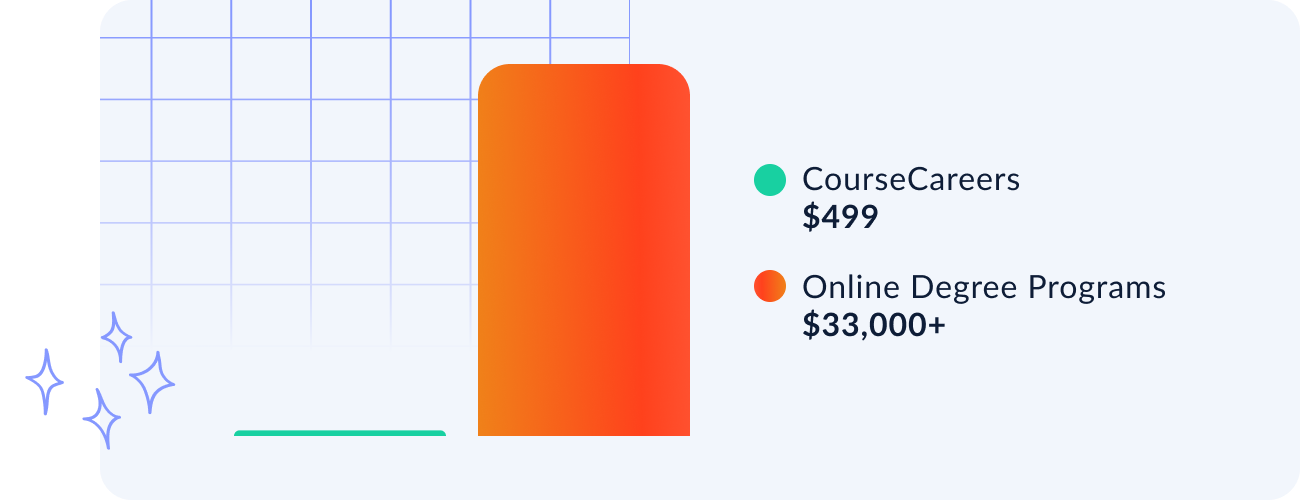

Online degree programs like WGU, SNHU, and ASU offer flexible ways to earn a credential, but they typically require years of coursework, tens of thousands in tuition, and a longer timeline before entering the job market.
CourseCareers flips that model: a $499 one-time investment, 1–6 months to job-ready skills, and alumni earning $60,000+ in their first year. That’s 5–80× cheaper and up to 8× faster than an online bachelor’s, without the debt or delay. Instead of building toward a diploma, every part of the experience is focused on building toward employment, with training, tools, and guidance designed to get you hired fast.





Online degrees can make sense for learners who want a formal academic credential, plan to pursue graduate education, or are targeting roles that explicitly require a bachelor’s degree. They are also a fit for people who value broad academic exposure and are comfortable with multi-year timelines before entering the workforce.
CourseCareers is designed for people pursuing degree-optional careers who want to focus only on job-relevant skills, build hiring readiness, and enter the workforce as quickly as possible. Instead of general education requirements, the training is structured around how specific entry-level roles actually operate and how employers evaluate candidates.
Cost:
CourseCareers: $499 flat. This represents a significantly lower upfront cost compared to multi-year online degree programs.
Time: Traditional online degrees require 2.5–4 years of coursework before you’re even ready to apply for roles. CourseCareers programs are designed to prepare learners for entry-level roles on a shorter timeline, allowing them to pursue employment sooner than multi-year degree paths.
ROI: Most online degrees take years to break even, especially with loan repayment. CourseCareers often pays for itself within a single week of work, shifting your return on investment timeline from years to days. That accelerated payoff means you can start building savings, advancing your career, and compounding earnings long before most degree students finish their first capstone course.
"I was just a full-time college student working odd jobs like in a warehouse when I started CourseCareers. I was literally only two-thirds of the way finished with the course when I had like 30 companies wanting to interview me. I now make $28/hr.”


These resources break down how career entry works without a traditional degree and what employers actually look for when hiring beginners:
Online degrees give you a credential, but CourseCareers builds a bridge to employment. It’s not just education; it’s a career launch platform designed to get you hired fast, earn more, and start building your future without the debt, delay, or detours of a four-year program.